


US Withdrawal from the Paris Agreement

On 6 November 2024 we learned that Donald Trump would become the 47th president of the United States of America. Grabbing headlines, courting controversy and ‘making America great again’, leaders around the world began to prepare for what a second Trump administration might have in store. A flurry of executive orders were signed on day one. Among them was a directive to withdraw from the Paris Agreement. This was only one of several orders signed relating to climate change. Others included measures to increase oil and gas production, and to remove the need to consider endangered species when developing fossil fuel infrastructure.
Under Trump’s first administration, the US left the Paris Agreement in 2017 only to then rejoin in 2021 once Joe Biden was elected. It will be a year before the US formally withdraws – article 28 of the Agreement provides that withdrawal can only take effect a year after notice is given to the UN. By withdrawing from the Paris deal, the US would join just three other countries who have not signed up: Iran, Libya, and Yemen.
What is the Paris Agreement
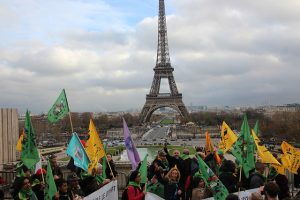 The Agreement is an international treaty which was born out of a series of climate negotiations in 2015. Almost all countries have signed up to it. It is considered one of the more significant multilateral steps towards dealing with the climate crisis. The key takeaway is that all signatories agreed to stem the increase in the global average temperatures to below 2°C above pre-industrial levels. Broadly, ‘pre-industrial levels’ means the level before the Industrial Revolution. Recognising the urgency attached to the climate crisis, not only did they agree a hard limit, signatories also agreed to pursue efforts to limit the temperature increase to 1.5°C. The UN’s Intergovernmental Panel on Climate Change has opined that crossing 1.5°C threshold risks catastrophic natural events which could severely impact the world.
Every five years, parties to the agreement submit Nationally Determined Contributions (NDC) to the UN, setting out how they are going to achieve the Agreement’s aims. The five-year cycle gives countries time to become ever more ambitious in their targets. The Paris Agreement also reaffirmed a commitment to help developing nations in dealing with the impacts of climate change and build greener economies by providing annual financial support. The current amount has been around £82 billion but the aim is for this to increase to £245 billion a year by 2035.
UK obligations under the Paris Agreement
In the UK, NDC’s were brought into force by the Climate Change Act 2008 (CCA) (which was amended after the Agreement was ratified).
On 30 January 2025, the UK formally submitted its NDC target for 2035 which will be to reduce greenhouse gas emission by 81% from levels recorded in 1990. This does not displace the target of a 68% reduction by 2030.
The UK’s NDC target was accompanied by a document with technical information which includes scope, timing, sectors, and greenhouse gases covered by the target. It also gives an overview of the relevant policies and measures involved in delivering the NDC.
This new 2035 target is in line with advice given by the Climate Change Committee. It has stated that a reduction of this nature would contribute towards limiting global warming to 1.5°C, a goal the world is currently on track to miss. The Government states that the policies and proposals needed to deliver carbon budgets as required under the CCA should align with those needed for 2030 and 2035 NDCs.
Impact of US Withdrawal
Before Trump’s election to office, the UN Secretary General Antonio Guterres stated that the Paris Agreement could survive if the US withdrew, but compared the departure to a human losing an important body part. Despite statements of continued support and calls to action by other member states, the US departure is likely to be very significant in terms of direct impact on global emissions reductions and influence on the targets of other countries. The US has long been one of the largest emitters of greenhouse gases in the world and leaving could allow other countries to relax their own targets.
What’s more, there are concerns that this could be the beginning of a domino effect, prompting other member states to leave too. Argentina, for example, under the leadership of Javier Milei is feared to be thinking about withdrawing. In circumstances where experts are sceptical about whether the 2°C target will be met, some warn that US withdrawal will make aspirations to keep warming below 1.5°C impossible.
